
Sprinkler System Watering
A lush, emerald yard is not just a fantasy. Regular watering and lawn care are all it takes to maintain vigorous green grass. To ensure your yard stays healthy, you need to understand how often to water it using a sprinkler system watering technique.
Watering your lawn too much or too little weakens the turfgrass and increases its vulnerability to diseases, pests, and other problems. Fortunately, we've created a guide that will give you the knowledge you need to plan when to water your yard.
In this article, we’ll cover:
How often should I water my lawn with a sprinkler system watering?
Shade
Soil types
Types of grass
Warm-season grasses
Cool-season grasses
Types of sprinklers
How much water does my lawn need?
Underwatering your grass
Overwatering your grass
How to measure sprinkler output
How to decide when to water your lawn
Time of day
Wind conditions
After you mow
Water restrictions
What time of year should you water your grass?
When do I stop watering my lawn in fall?
When do I start watering my lawn in the spring?
How to set your sprinkler system watering
Digital timers
Mechanical timers
Benefits of regularly watering your lawn
FAQs about how often should I water my lawn
In humid weather or during the hottest summer months when the lawn is exposed to the sun's heat, lawns require more water. Otherwise, your grass could become a haven for lawn pests due to drought and hot weather.
Many factors determine how frequently your grass needs to be watered:
Amount of shade your yard gets
Local temperatures and climate
How windy it is
Type of grass
Age of grass
Soil type
Size of watering zone
How effectively the soil drains
Water your lawn every other day for optimal results. This implies that you should water your yard three times a week on average.
Don't worry about watering the lawn after a strong downpour because some places get a lot of rain. If not, you waste water and run the risk of overwatering your grass, which will harm your lawn's health.
You can use this chart to figure out how often you should water your yard in the summer and other warm seasons:
Temperature (Fahrenheit) | Number of times you should water the lawn |
60 degrees or lower | 1-2 times a week |
70 to 80 degrees | 3 times a week |
90 degrees or higher | 3-4 times a week |
Avoid watering your yard every day. Light watering every day causes shallow roots, which erode the lawn and cause it to dry out quickly. Watering thoroughly but less regularly will help your grass grow deep roots, so it's not a time-saving tactic.
You don't need to worry if your grass appears strong and healthy because lush green growth is a sign that your lawn is in great shape.
But if you see symptoms of an unhealthy or unhappy lawn, it's likely that there's a problem, and your watering practices could be the cause. Be sure to take into account the various elements that influence how frequently you should water your grass.
Shade
Because the sun doesn't quickly dry out the moisture in the grass, shaded parts of the yard hold onto moisture longer. You will need to water your lawn less frequently if it receives more shade. More frequent watering is required for yards that receive continuous direct sunlight.
Soil Types
Different soils retain moisture in varying ways. By understanding your soil type, you can tailor your sprinkler system watering schedule. Here's a breakdown:
The saturation levels of different types of soil vary. The kind of soil and the particular qualities and traits of each type determine how long a soil holds rainwater.
Find out what kind of soil you have. You can plan how often and for how long to water your grass by understanding the characteristics of the soil type in your yard.
Clay-based Soil: Clay soil, which is frequently found in the warm Midwest and South, holds moisture effectively and requires less watering. Water runoff in your yard might result from overwatering clay soil since it absorbs water slowly.
Loamy Soil: Dense loamy soils are ideal for growing grass. Although they are prone to floods because of their poor drainage, they hold water very effectively, which reduces the frequency of watering.
Sandy Ground: Sandy soil is frequently found close to creeks, rivers, and the seaside. Grass planted on sandy soil will require more regular watering because of the soil's poor water retention.
Types of Grass
Every type of grass is unique, and some require more water than others. When planning a watering schedule for your lawn, you need to factor in your yard’s grass type since that influences how much water your yard needs.
Grass types are split into two categories: warm-season grasses and cold-season grasses.
Warm-season grasses
As the names suggest, warm-season grasses grow in warmer climates, so they are most commonly found in Southern states. They can be watered more sparsely, about every two to four days.
For best results, warm-season grasses should be watered regularly. Here is the suggested amount for different types of warm-season grasses:
Type of grass | How much you should water per week |
Bahiagrass | ½ to ¾ inch |
Bermudagrass | ½ to 1 inch |
Centipedegrass | 1 inch |
St. Augustinegrass | 1¼ inch |
Zoysiagrass | ¾ inch |
Warm-season grasses, which are well-known for their ability to withstand drought, prefer arid environments and flourish in temperatures as high as 90 degrees Fahrenheit.
Cool-season grasses:
Cool-season grasses typically flourish in Northern states because they prefer colder weather. Cold-season grass lawns require more frequent watering since they are less suited to drier regions than warm-season grasses.
When the temperature warms up, your cool-season turfgrass will require the following amount of water:
Type of grass | How much you should water per week |
Kentucky bluegrass | 1½ to 2 inches |
Perennial ryegrass | 1 inch |
Tall fescue | 1 to 2 inches |
The 70–80 degree Fahrenheit temperature range is more conducive to the growth of cool-season grasses. They require watering every other day throughout the summer because they prefer chilly climates and are less drought-tolerant than warm-season grasses.
Types of Sprinkler
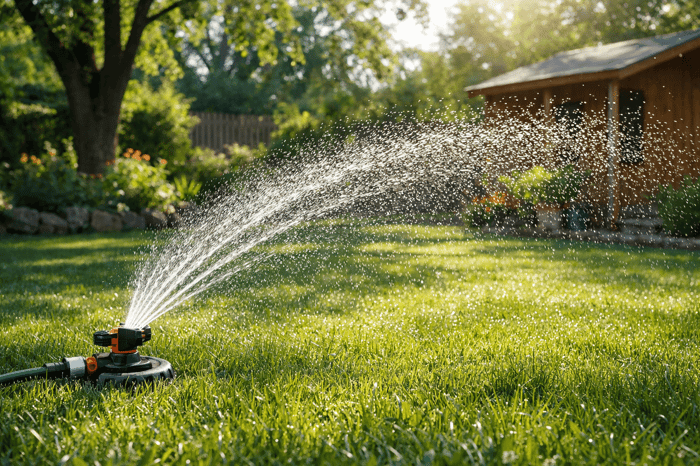
Each sprinkler covers a separate zone, which is a specific portion of the yard. The effectiveness of your sprinkler system and the amount of ground it covers during a watering session will depend on the type of sprinkler head you use.
Different sizes of yards call for different kinds of sprinkler heads.
Oscillating sprinklers work best for vast lawns.
Rotary sprinklers work well for medium-sized or larger lawns.
Stationary sprinklers work best in tiny yards because they cover a small area.
An alternative to a conventional sprinkler system watering is drip irrigation. By trickling water droplets from a hose straight onto the soil, drip irrigation gradually delivers water to the ground instead of saturating your grass with a torrent of water spray.
How much water does my lawn need?
A lawn typically requires 1 to 1½ inches of water per week. Finding a way to space out watering sessions throughout the week is ideal because it typically takes an hour to get one inch of water.
Water your lawn three times a week for 20 minutes each under typical circumstances. Every session, the grass should receive roughly ⅓ inch of water.
You can also water your grass in two 30-minute sessions if you'd like. Your grass should receive approximately ½ inch of water during a half-hour watering session.
Remember that the length of time you should water your yard depends on the sort of sprinkler head you have:
Spray heads: Water for 5 or 10 minutes
Rotor heads: Water for 20 to 30 minutes
MP rotator heads: Water for 20 to 30 minutes
Drip system: Water for 20-30 minutes
When there are rainstorms in your neighborhood, rain sensors are a handy tool for controlling when to water your plants. These sensors stop planned waterings when they detect moisture in the air. This practical tip will prevent overwatering of your lawn while also saving money and water.
It's important to be like Goldilocks and figure out how much water your lawn needs. You don't want to water it too much or too little, but rather the ideal amount for your grass. Take cautious not to submerge or overwater the yard.
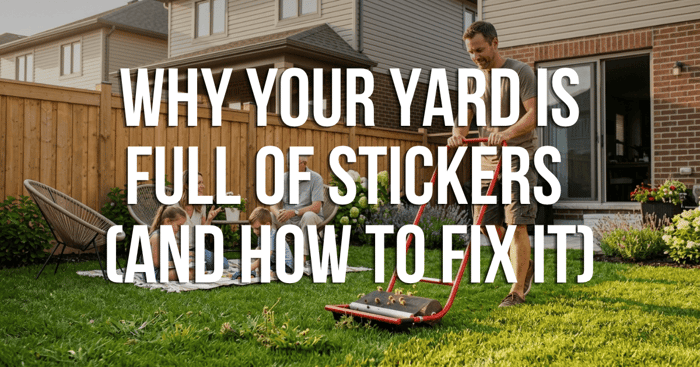
Sticker Burr Roller – A Must-Have Tool
In addition to regular watering, it's important to use tools like the sticker burr roller to maintain a healthy lawn. A sticker burr roller can remove these annoying weeds and ensure that your turfgrass grows without unnecessary competition from undesirable plants.
Putting Your Grass under Water
Your grass may turn yellow and remain dormant until the drought subsides if there is a severe drought and water conservation is required.
If not, it's crucial to ensure that your yard receives the water it requires to flourish in the summer or other arid seasons.
Seek out indicators that your landscape requires watering:
Yellow or brown patches
Footprint indents in grass
Dying grass
Grass looks dull instead of springy and erect
Tips of grass blades start to curl
In order to keep your yard healthy and green, you should water it more frequently when you see any of these symptoms.
Screwdriver test: To determine how dry your soil is, drive the end of a screwdriver into the ground. It should be possible for a screwdriver to go 6–7 inches into the earth. Water your lawn more frequently each week if you have problems driving a screwdriver into the ground.
Overwatering your grass
Watch out for these symptoms of overwatering your lawn because it can damage the grass:
Yellowing or discolored grass
Puddles of water around your yard
Runoff
Invading weeds
Mushrooms or fungal growth
Lawn insects
Thatch buildup
Mushy or spongy ground
Rotting or shallow roots
Because they prevent roots from getting nutrients from the soil, weeds are more likely to thrive in an overwatered yard and could harm your grass.
Reduce the amount of time you spend watering your yard until you figure out how much water it requires each week if you are overwatering your lawn.
Sticker Burr Roller for Lawn Care
To keep your lawn pristine, don’t forget the sticker burr roller. It effectively removes troublesome sticker burrs that can damage your grass and make it uncomfortable for you to walk on. If you're tired of dealing with stubborn burrs, using a sticker burr roller can save you time and effort, ensuring your lawn remains as beautiful as possible.
How to measure sprinkler output
Every sprinkler system's water production must be calculated. However, how can you determine how much water is getting into your lawn?
A sprinkler system's water output during a watering session can be measured using rain gauges or empty tuna cans. You can use a pie dish or another container with a comparable shape if you don't have a tuna can or rain gauge.
Turn on the sprinkler system and place a rain gauge in the watering zone. If using a tuna can, place it in the area of the yard that is watered by sprinklers.
Measure the volume of water in the container once the sprinkler has finished its cycle. You can gauge how much water the sprinkler shot out by measuring the depth of tuna cans, which are around an inch.
To make sure your grass receives all the water it requires, you might need to modify your watering plan or troubleshoot your sprinkler system if the watering isn't sufficient.
How to decide when to water your lawn
Before setting your sprinklers, you should think about the best time of day for them to operate, whether it's better to run them at night or in the morning, and other climate-related considerations.
Time of day
Early in the morning, between 6 and 10 a.m., is the ideal time of day to water your lawn. The ideal time to water your grass is before 8 a.m. It is best to water your lawn as soon as possible.
In the afternoon, the water is too rapidly evaporated by the sun to properly seep into the roots, which are the area of your lawn that need watering.
The dew remains on the grass overnight because the moisture doesn't have time to evaporate at night. Watering at night raises the risk of fungal or grass disease issues.
Additionally, you can water your lawn between 4-6 p.m., right before the sun sets. Before nightfall, it will have enough time to evaporate from your lawn and seep into the roots.
Wind conditions
Watering should be avoided on windy days. Otherwise, the water droplets in your yard would be blown away by the wind, which will hinder the roots' ability to absorb the necessary water.
After you Mow
Don't water your grass for at least 24 hours after you mow it. Giving your lawn a few hours to recover from the stress of cutting the grass enables the turfgrass to recover. The risk of fungal infections in your yard is increased if you water it immediately after mowing.
Water Restrictions
If there are water restrictions in your area, water with caution. Homeowners and businesses must abide by water restrictions during droughts or water shortages.
The days and hours that homeowners are permitted to irrigate their lawns are determined by water restrictions. This preserves precious water resources, which lowers waste. Check for local water limitations before establishing a water schedule, and then adjust your yard watering schedule accordingly.
What time of year should you water your grass?
Your lawn doesn't require watering in the winter, but it consumes a lot of water in the summer. Depending on the environment where you live, it might be difficult to determine when to start and stop watering your grass throughout the year.
When do I stop watering my lawn in fall?
Stop watering your yard when the grass falls dormant during the colder months.
The type of turfgrass and the climate in your area will determine when you should stop. While warm-season grasses grow dormant more quickly, cool-season grasses require more frequent watering.
The following are indicators that it's time to stop watering your grass for the year:
Lawn has stopped growing
Night temperatures are reaching 40 degrees Fahrenheit
Temperatures drop to the 30s
The ground freezes
Particularly in warm regions, grass will continue to grow by developing a deeper roof system well into the fall. Therefore, until the cold winter months arrive and your lawn becomes dormant, it still needs one inch of water every week in the fall.
When do I start watering my lawn in the spring?
There are indicators that let you know when to begin watering your grass in the spring after a long, hard winter filled with snowstorms and bitter cold:
Every day, the temperature rises over 40 degrees Fahrenheit.
Your yard's turfgrass and dirt have thawed.
It's fairly dry in your yard.
The grass has begun to grow and is no longer dormant.
How to set your sprinkler system
Homeowners can arrange automatic sprinklers to water the lawn at a predetermined time, which makes them convenient. By doing this, homeowners can save spending time manually watering their yard.
You can program your sprinkler system to water your grass automatically at any time of day by using the timer that comes with every high-quality sprinkler system.
Sprinkler systems employ one of two kinds of timers:
Digital timers, which use electronic circuits. The most widely used timers are digital ones.
Mechanical timers, which use gears and metal pins.
Although both mechanical and digital timers are automatic, their settings differ greatly.
Digital timers
A program switch is typically present when setting a digital timer, enabling you to alternate between settings like "run" and "stop."
A digital timer can be set by:
To "run," slide the program switch.
Decide the water zone you wish to use for your sprinklers. Zones will probably be referred to as "Zone 1," "Zone A," or by a similar nomenclature. The schedule must be established for each water zone.
Decide on the current time and date. For your timer to know when to activate the sprinklers, it must be programmed with the current time.
Enter the amount of minutes you would like your sprinklers to run to set the runtime.
Decide which days you would like your sprinklers to operate.
For every irrigation zone, repeat these procedures.
Mechanical timers
Because they are powered by gears, mechanical timers function differently from digital timers. If your sprinkler system is equipped with mechanical timers, you should take the following actions:
Place the pin in the time slot adjacent to the desired sprinkler system operation time. For the duration of time you want your sprinkler system to operate, insert pins.
If the sprinkler system has more than one zone, leave a gap in the timer.
Turn the dial to set the current time.
If you wish to operate your sprinkler system more than once during the day, you can place extra pins into different time slots.
In order to prevent watering, pins must be forced down.
This is how each irrigation zone should be configured.
Turning the dial to "off" or "stop" should be easy if you ever need to shut off your sprinkler system. Your sprinkler system should have an "off" switch that will prevent it from operating again until you turn it back to "on" or "run."
Benefits of regularly watering your lawn
In addition to keeping your grass from turning yellow, a well-watered lawn makes it more resilient to damaging illnesses and pests. Above all, though, a well-watered lawn maintains its health.
If you don't water your lawn, it becomes weaker and your turfgrass becomes less healthy. Maintaining the health of your yard requires routine sprinkler system watering irrigation. Numerous advantages come with having a healthy lawn:
Absorbs sound
Produces oxygen
Absorbs rainwater
Reduces erosion, runoff, and flooding; cleans water of impurities and enhances groundwater quality; and offers a suitable surface for outdoor activities.
Keeps the yard cool, which aids in heat dissipation and temperature regulation.
Increases curb attractiveness
FAQs about how often I should water my lawn?
Is a sprinkler system watering or a hose a better way to irrigate the lawn?
Since both sprinkler systems and hoses have benefits, it comes down to personal preference. Among the distinctions are:
Compared to sprinklers, hoses typically consume 60% less water.
Water bills are reduced since hoses use less water than sprinklers.
Sprinkler systems are stationary, whereas hoses are more mobile and adaptable.
Sprinklers waste a lot of water through evaporation; hoses use less water.
A uniform layer of water spray is applied to the grass by lawn sprinklers.
Purchasing a hose is far less expensive than installing sprinkler systems.
While watering with a hose requires you to manually move the soaker hose, sprinklers may be timed and scheduled.
Sprinklers raise your home's value.
For soaking roots, hoses work best.
How much does it cost to install a sprinkler system watering?
Depending on the size of the project, installing an in-ground sprinkler system watering can cost anywhere from $2,400 to $4,200. It will therefore cost you between $0.20 and $1 per square foot.
The following variables affect the cost of installation:
Lawn size
Type of sprinkler system
Number of watering zones
Steepness of slopes in your yard
Maintenance costs
Is a DIY sprinkler installation better than hiring a pro?
You can choose to install your sprinkler system watering yourself rather than hiring a professional if you'd rather try a do-it-yourself project.
Given that a DIY sprinkler installation kit costs between $130 and $260, which is significantly less than hiring a professional, a do-it-yourself installation ought to be less expensive.
However, doing sprinkler installation oneself can be difficult and time-consuming, particularly for homeowners who are unfamiliar with similar home remodeling chores. Installing your own sprinkler system watering can be a challenging burden if you lack the necessary knowledge.
Get the lush lawn of your dreams
In addition to saving you time and money, installing an autonomous sprinkler system will maintain the robust and healthy appearance of your grass. If you are looking to transform your lawn then Sticker Burr Roller is the perfect choice. They have highly trained professionals who come with state of the art tools and techniques. You won't have to worry about your lawn after your sprinklers are set up to water it every day of the week. Never be afraid to engage a professional to fix any damage to your existing irrigation system or to install a sprinkler system in your yard.
Sticker Burr Roller – Your Solution
Don't let sticker burrs ruin your lawn’s health. A sticker burr roller can effectively remove these invasive plants, giving your lawn the best chance to thrive.
By following lawn irrigation tips and maintaining a consistent sprinkler system watering schedule, you can enjoy a vibrant, healthy lawn throughout the year. Consider using a Sticker Burr Roller for additional lawn care. This simple tool ensures your lawn stays pristine and free from unwanted weeds.
Remember, maintaining your lawn isn't just about watering. It’s also about using the right tools and techniques. Be sure to adjust your sprinkler system watering based on the seasons and the unique needs of your lawn.
www.StickerBurrRoller.com